
TINY TOWNS + PUBLIC ENGAGEMENT Longer Tables, Bigger Connections
TINY TOWNS + PUBLIC ENGAGEMENT
Longer Tables, Bigger Connections
Colorado’s smallest communities know something important about public engagement: it works best when it feels like community, not a meeting.
At a recent Downtown Colorado, Inc. Tiny Towns conversation, leaders and staff from communities across Colorado shared how they bring people together, what they are working on, and how food, storytelling, traditions, and trusted gathering places can create stronger civic participation. The conversation also featured Tim Jones of Longer Tables, who invited Colorado communities to take part in a statewide effort to set 150 tables across Colorado in celebration of Colorado’s 150th anniversary.
Engagement starts where people already gather
In small communities, public engagement often happens around a meal, at a holiday event, in a park, or during a familiar local tradition. The best examples shared were not overly formal. They were simple, relational, and rooted in place.
- Cripple Creek shared several ways the community reaches residents and creates space for connection. With roughly 1,100 residents but a much larger daytime population due to casino and mining employment, the city faces the challenge of engaging both locals and commuters. Recent examples included a Cinco de Mayo block party, local-focused events, and Wednesday lunches hosted by Community of Caring, where elected officials and staff can sit down with residents in a casual setting. Cripple Creek also discussed ideas such as school-game tailgates, Christmas tree lighting, residential and commercial lighting contests, and using beloved local assets like the town’s donkeys and historic stories to draw people in.
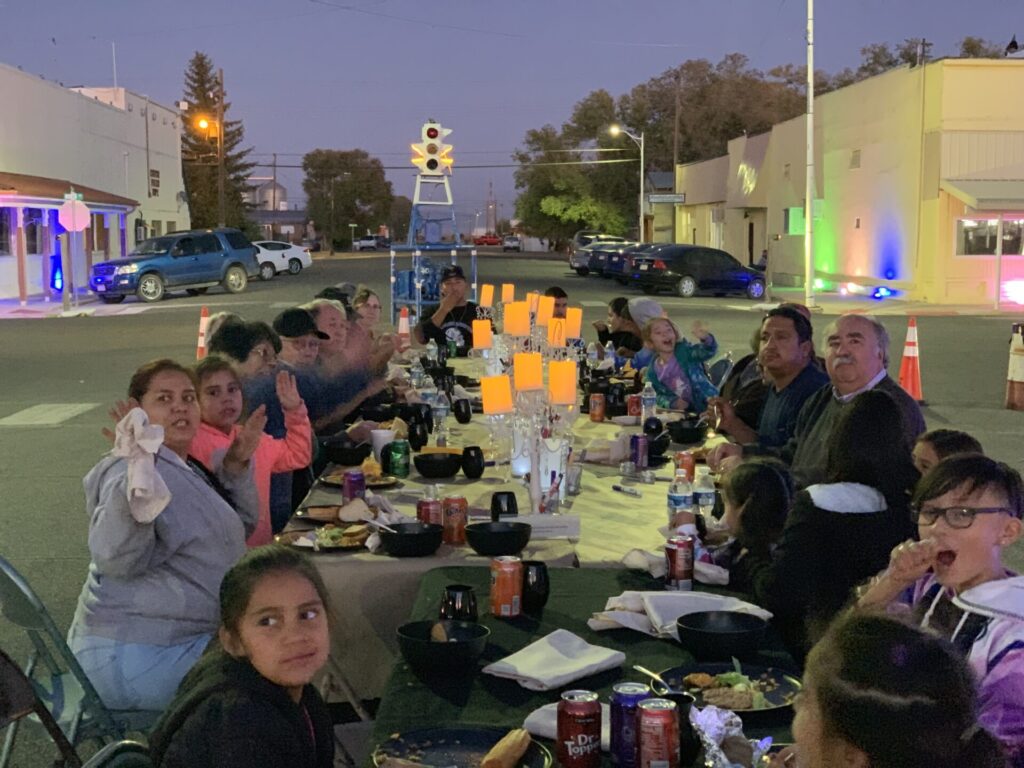
- Victor, with a population between about 300 and 400, emphasized the power of feeding people. For community meetings and events, Victor has found that good food and full bellies help create a more welcoming environment. The conversation also touched on Victor’s visual and historic character, including the possibility of setting a long table down Main Street as a memorable image of small-town connection.
- Blanca shared a familiar tiny-town challenge: even with flyers around town, free food, and a park dedication that served nearly 300 people, local turnout and feedback can still be difficult to generate. Blanca is continuing to look for ways to bring residents into conversations about the park and future community events, including possible Fourth of July activities. The Longer Tables model could offer a low-barrier way to invite people into conversation without making engagement feel like another public meeting.
- Red Cliff offered a powerful example of how community traditions can become the foundation for engagement. With about 250 residents, Red Cliff has seen strong participation in movie nights at town hall, third-Thursday potlucks, Christmas caroling from a decorated town truck, Santa visits with personalized gifts for local kids, cookie decorating, Thanksgiving dinner with bingo, Community Unity Day, outdoor summer movies, a soup swap, and possible game nights. Some events stay purely social, while others, like town cleanup and Community Unity Day, are natural opportunities to ask bigger civic questions.
LONGER TABLE OPPORTUNITIES FOR COLORADO 150
Tim Jones of Longer Tables (https://www.longertables.org/) shared a simple but powerful idea: the table is one of the best places to rebuild connection, reduce isolation, and help people encounter one another as neighbors.
The Longer Tables model is intentionally simple. Communities set a long table, invite people to sit with those they may not already know, share food, and use story-based conversation prompts. The goal is not to hold a formal public hearing. The goal is to create a setting where people slow down, listen, and reconnect.
For Colorado’s 150th anniversary, Longer Tables is inviting communities to help set 150 tables across Colorado between now and the end of November. Tables can be small or large, indoor or outdoor, potluck-style or community-hosted. Participating communities receive guides, templates, social media materials, conversation prompts, and support for hosting.
For Tiny Towns, this is an especially exciting opportunity. A table of 40 people in a town of 250 is not just a nice turnout — it is a significant percentage of the whole community. Smaller communities may be uniquely positioned to lead the state in showing what meaningful participation looks like.
A fun challenge emerged from the conversation: Which tiny town can bring the largest percentage of its population to the table?
TINY TOWN TIPS FOR OTHER COMMUNITIES
The conversation surfaced several lessons that apply far beyond small towns:
- Public engagement works better when it is attached to something people already value: food, holidays, kids, music, traditions, service days, and local pride.
- Engagement does not always need to start with a survey or a public hearing. Sometimes it starts with a bowl of soup, a bingo card, a movie night, or a conversation over lunch.
- Small communities are already experts at “longer tables.” Colorado 150 is a chance to celebrate that strength, tell those stories, and invite more people to pull up a chair.
ABOUT DCI TINY TOWNS
Tiny Towns is Downtown Colorado, Inc.’s informal peer network for Colorado communities with populations under 2,000. Designed for town managers, downtown managers, elected officials, staff, volunteers, and local leaders doing big things with small teams, Tiny Towns creates a welcoming space to share ideas, troubleshoot challenges, and connect with others who understand the realities of small and rural community work.
One part fun, one part education, and one part therapy, Tiny Towns meets monthly through a virtual call where participants can share updates, discuss timely topics, learn about helpful programs and resources, and exchange practical solutions with peers across the state.
The program recognizes that small towns often face outsized responsibilities with limited staff, funding, and capacity. By bringing tiny communities together, DCI helps local leaders build relationships, discover new tools, celebrate creative approaches, and remember that they are not doing this work alone.
Tiny Towns is intentionally informal, responsive, and community-driven. Topics may include downtown revitalization, community engagement, housing, infrastructure, events, grant opportunities, main street strategies, volunteer recruitment, local business support, placemaking, historic preservation, and the everyday problem-solving that keeps small towns moving forward.
Whether your community is navigating a big project, looking for fresh ideas, or simply needs a trusted group of peers who understand tiny-town realities, Tiny Towns offers a place to connect, learn, laugh, and keep doing big work in small places.